
Lea el artículo completo a continuación. Y visita https://cantaroinstitute.org/.

“Therefore doth my Father love me, because I lay down my life, that I might take it again. No man taketh it from me, but I lay it down of myself. I have power to lay it down, and I have power to take it again. This commandment have I received of my Father” (Jn. 10:17-18).
“As they had often plotted to kill Him, He tells them their efforts will be useless, unless He is willing. I have such power over My own life, that no one can take it from Me, against My will. This is not true of men. We have not the power of laying down our own lives, except we put ourselves to death. Our Lord alone has this power. And this being true, it is true also that He can take it again when He pleases: And I have power to take it again: which words declare beyond a doubt a resurrection. That they might not think His death a sign that God had forsaken Him, He adds, This commandment have I received from My Father; i. e. to lay down My life, and take it again. By which we must not understand that He first waited to hear this commandment, and had to learn His work; He only shows that that work which He voluntarily undertook, was not against the Father’s will.”
-Chrysostom (c. 347-407)

I. Dios desde la eternidad, por el sabio y santo consejo de su voluntad, ordeno libre e inalterablemente todo lo que sucede. (1) Sin embargo, lo hizo de tal manera, que Dios ni es autor del pecado (2), ni hace violencia al libre albedrío de sus criaturas, ni quita la libertad ni contingencia de las causas secundarias, sino más bien las establece. (3)
1. Efesios 1:11; Romanos 11:33, 9:15,18; Hebreos 6:17.
2. Santiago 1:13,17; 1 Juan 1:5.
3. Hechos 2:23; 4:27-28; Mateo 17:12; Juan 19:11; Proverbios 16:33.
II. Aunque Dios sabe todo lo que puede suceder en toda clase de supuestas condiciones, (1) sin embargo, nada decreto porque lo preveía como futuro o como cosa que sucedería en circunstancias dadas. (2)
1. Hechos 15:18; 1 Samuel 23:11-12; Mateo 11:21,23.
2. Romanos 9:11,13,16,18.
III. Por el decreto de Dios, para la manifestación de su propia gloria, algunos hombres y ángeles (1) son predestinados a vida eterna, y otros preordenados a muerte eterna. (2)
1. 1 Timoteo 5:21; Mateo 25:41.
2. Romanos 9:22-23; Efesios 1:5-6; Proverbios 16:4.
I. Although the light of nature, and the works of creation and providence, do so far manifest the goodness, wisdom, and power of God, as to leave men inexcusable;a yet are they not sufficient to give that knowledge of God, and of his will, which is necessary unto salvation;b therefore it pleased the Lord, at sundry times, and in divers manners, to reveal himself, and to declare that his will unto his Church;c and afterwards, for the better preserving and propagating of the truth, and for the more sure establishment and comfort of the Church against the corruption of the flesh, and the malice of Satan and of the world, to commit the same wholly unto writing;d which maketh the holy Scripture to be most necessary;e those former ways of God’s revealing his will unto his people being now ceased.f
a.Psa 19:1-3; Rom 1:19-20; 1:32 with Rom. 2:1; 2:14-15. b. 1 Cor 1:21; 2:13-14. c. Heb 1:1. d. Prov 22:19-21; Isa 8:19-20; Mat 4:4, 7, 10; Luke 1:3-4; Rom 15:4. e. 2 Tim 3:15; 2 Pet 1:19. f. Heb 1:1-2.
– Westminster Confession of Faith (1646), 1.1, Of Holy Scripture
Half a lifetime ago now, as I was hitting golf balls at a driving range, the older man in the next booth offered me his brand-new, state-of-the-art, high-tech, large-headed driver. “Try this one, son,” he said. He insisted. I laid aside my old wooden-headed club (it cost £5 secondhand) and tried his ultramodern metal-headed version. The ball flew off the clubface and was still in the air as it flew past my earlier attempts. Suddenly, golf seemed easier, my swing so much more powerful.
I couldn’t believe it. Nor could I afford my own high-tech driver. But, I thought, this must be what the resurrection body in the state of glory is like. No longer weak, but powerful; obedience no longer a struggle against the world, the flesh, and the devil—but natural, the smooth and happy tempo of a sin-free world. If I can enjoy this new technology in a golf shot, how wonderful it will be to live in the full blaze of God’s presence.
Read more, by Sinclair Ferguson

Así dice el apóstol Santiago (Santiago 5:13). Así también adoraban al Señor todos los puritanos de Nueva
Inglaterra en sus reuniones de iglesia del día del Señor, cantando salmos a capella de versiones métricas y rimadas del salterio. Esta era la adoración antigua de nuestros antepasados piadosos, la cual creían que era una ordenanza del Nuevo Testamento.
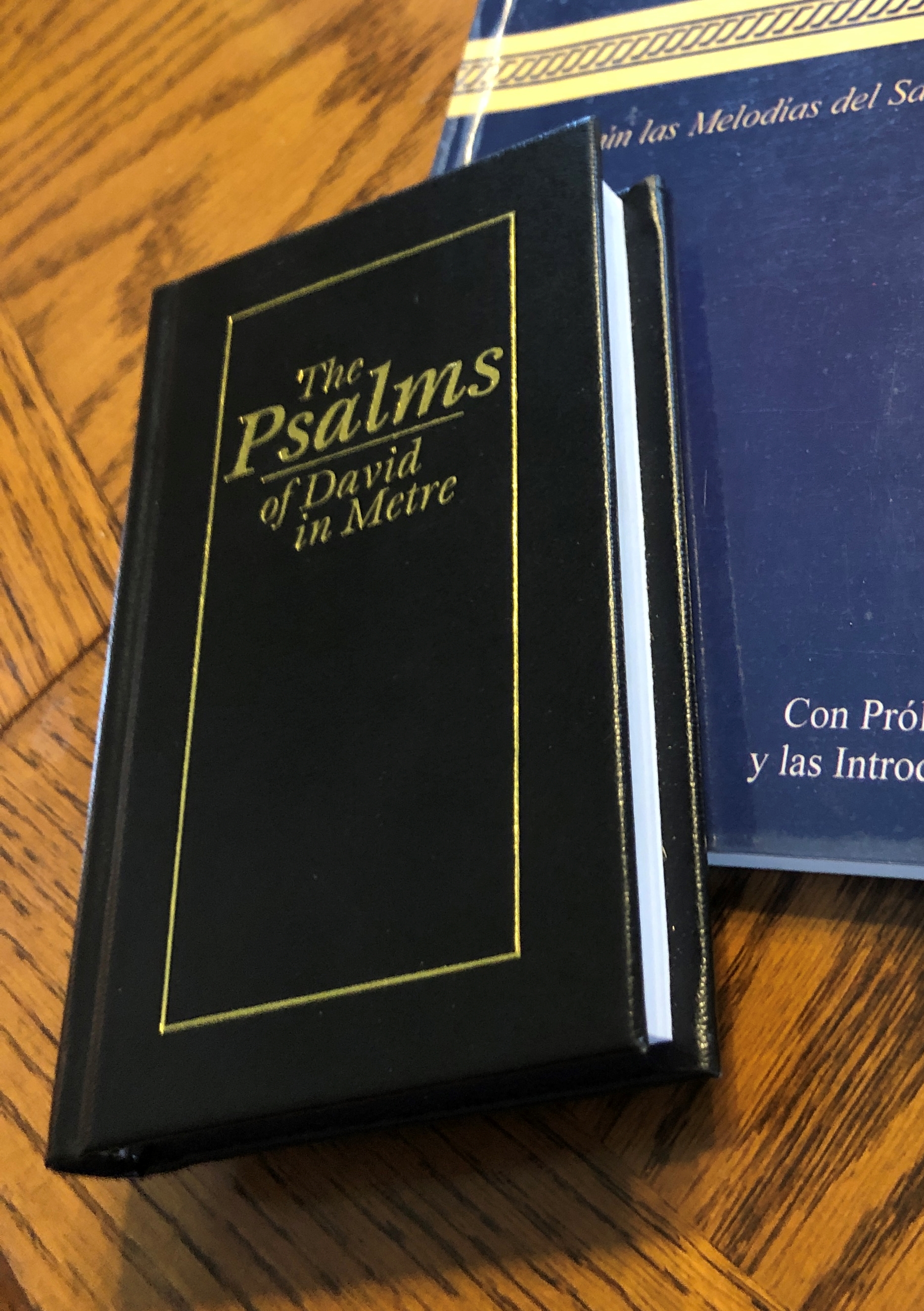
Con el fin de despertar entre los cristianos de Nueva Inglaterra la práctica de cantar los salmos, estamos ofreciendo copias gratuitas de Los salmos métricos de David (1650) a las que respondan desde cualquier lugar de Nueva Inglaterra. Si desea intentar cantar los salmos, intente unirse aquí. Para obtener una de estas copias gratuitas, escríbame a: mjives dot refparish at gmail dot com. Incluya su dirección, y se lo enviaremos por correo.

Considere cómo Juan Calvino recomienda el cantar salmos en su prefacio al salterio de Ginebra de 1543:«Por tanto, ¿qué se ha de hacer? Pues tener canciones no solamente honestas, sino también santas, las cuales nos sean como aguijones para incitarnos a orar y alabar a Dios, a meditar en sus obras, a fin de amarlo, temerlo, honrarlo y glorificarlo. Mas esto que dices. Agustín es cierto, que nadie puede cantar nada digno de Dios, sino lo que ha recibido de Él. Por lo cual, cuando hayamos andado por todas partes par buscar aquí y allá, no encontraremos mejores canciones ni más apropiadas que los Salmos de David; los cuales el Espíritu Santo le dictó e hizo. Y por consiguiente, cuando los cantamos, estamos seguros que Dios nos pone en la boca las palabras, como si Él mismo cantara en nosotros, para exaltar Su gloria. Por lo cual, Crisóstomo exhorta tanto a hombres como a mujeres y niños pequeños, a que se acostumbren a cantarlos, a fin de que esto sea una meditación para asociarse a la compañía de los ángeles.»
Thus, the Apostle James (Jas. 5:13). Accordingly, the New England Puritans and colonial Presbyterians worshipped the Lord in their church meetings with a capella psalm singing to metrical, rhymed versions of the Psalter. Our godly forefathers worshipped this way, believing it to be the rule for all the New Testament churches. To learn more, see here and here.
In the interests of reviving psalm-singing among Christians in the northeast, we are giving away five free copies of The Psalms of David in Metre (1650) to the first five who respond from anywhere in New Jersey, greater Philadelphia, or the New York metro — provided you don’t already belong to a psalm-singing (EP) church or already have a copy. If you would like to try signing the psalms, try joining in here. To get one of these free copies, drop me a note at michael at reformedparish dot com with your address, and we’ll drop it in the mail.
Consider John Calvin’s commendation of psalm-singing in his preface to the Geneva Psalter of 1543:
So what are we to do? We should have songs that are not only upright but holy, that will spur us to pray to God and praise Him, to meditate on His works so as to love Him, to fear Him, to honour Him, and glorify Him. For what St. Augustine said is true, that one can sing nothing worthy of God save what one has received from Him. Wherefore though we look far and wide we will find no better songs nor songs more suitable to that purpose than the Psalms of David, which the Holy Spirit made and imparted to him. Thus, singing them we may be sure that our words come from God just as if He were to sing in us for His own exaltation. Wherefore, Chrysostom exhorts men, women, and children alike to get used to singing them, so as through this act of meditation to become as one with the choir of angels.”
Creo que cuando las personas miran el bautismo, tienen una comprensión limitada de por qué Jesús ordenó que bauticemos a Sus discípulos. La mayoría de las personas probablemente asocian el agua con la limpieza, que es una conexión precisa dado el mensaje del profeta Ezequiel de que Dios rociaría agua sobre Su pueblo (Ez. 36:25). La limpieza del pecado, sin embargo, es solo un elemento en el significado e importancia del bautismo.

 The Reformed Parish