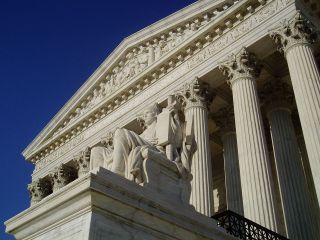
 In the last several weeks, we’ve seen several states struggling to come to terms with the ramifications of the Supreme Court’s Obergefell vs. Hodges decision. Most recently, Mississippi has passed a law protecting the freedoms of pastors, florists, and bakers, who do not wish their consciences implicated by the new reality. They have lost the battle but are hoping to safeguard their right of dissent and simple non-participation. Let anyone who wishes to support same-sex marriages do as they please, but these folk simply want left out of it. That, however, is bringing down quite the storm of righteous protest from all quarters, from entertainers, to big business, to those in public office. New York Governor Andrew Cuomo is just the most recent to join in the denunciation, backing it up with the rod of discipline for his errant, backward un-Americans.
Yes, Obergefell vs. Hodges was truly a watershed moment; but really, one could see it coming miles away. The court of public opinion had already ruled before Justice Kennedy penned his majority opinion. Kennedy only enshrined into law – by judicial fiat, no less – what had already become the new righteousness of modern America. It scratched the itch. Not an itch for true justice. Yes, many would think that’s just what it was. A fundamentally good America was simply becoming more consistently good. This was Civil Rights redivivus. But I see it differently – America was instead itching for justification.
Here’s the problem. We are not the impeccable, squeaky-clean nation that we’d like to imagine ourselves to be. We are rather depraved. And I’m not just speaking theologically here. We are actually, tangibly, viscerally depraved. The disease has reached the skin, and the stinking wounds are drawing flies. It has become painfully obvious. We are dirty, down to the fingernails. And when we look in the mirror, we just don’t like what we see. We want to be clean. We want innocence back. We want to be rid of the nagging voice of conscience that rings in our ears, “We have abandoned God and played the prodigal. We have lost our spiritual virginity and have defiled the core of our beings.” But that’s just way too painful. So we desperately reach for cosmetics. We look for a new justification, to vindicate our consciences short of coming clean before God and the world.
Many Americans try to project their dirtiness on to others – playing some psychological slight-of-hand. “It’s really the politician.” The voter is innocent. The polls are never wrong (and the customer is always right)! But once that voter becomes elected and enters the Beltway, he falls from grace. At term’s end, a righteous, holy majority may well vote him or her out of office as a punishment for going bad.
But the facts tell a different story. No-fault divorce is now the norm. Porn is now the norm. Shacking up is now the norm (if you have to Google that, you’ve proved my point). Governor Cuomo is doing just that. No commitment, free sex. How noble! But I wish I could say he’s any different from Joe Six-pack. Children across the United States are now accustomed to being tossed around like a Frisbee from home to home because their parents act like spoiled children. Is it any wonder this new generation is so troubled? Yet, at least they’ve survived the abortion epidemic.
To me, it seems rather obvious. Our nation joins the latest crusade in order to find justification on their own terms. It finds a new cause, a new righteousness – however warped. By championing that new righteousness, dignity is restored. The feeling of worth and value comes back with a flush. And when the baddies, who hold out for an older righteousness, speak their mind, they are shouted down. At best, they are marginalized – haters gonna hate!
I have little confidence in the American public, apart from God’s restraint. The jury is corrupt, full stop. But I have every confidence that when a sovereign God hears the prayers of His people, when He freely chooses to have mercy on whom He will have mercy, that nothing will stop the revolution in the minds of the people. That He can – when He pleases – stop the madness and bring back a prodigal nation in the mud of the pigpen to its senses. He can persuade America to renounce its new righteousness, its new justification, and receive His through Christ.
“For all have sinned, and come short of the glory of God; being justified freely by his grace through the redemption that is in Christ Jesus: whom God hath set forth to be a propitiation through faith in his blood, to declare his righteousness for the remission of sins that are past, through the forbearance of God; to declare, I say, at this time his righteousness: that he might be just, and the justifier of him which believeth in Jesus” (Romans 3:23-26)

 “. . . the return of Christ unto judgment is not an arbitrary addition that can be isolated from his preceding work and viewed by itself. It is a necessary and indispensable component of that work. It brings that work to completion and crowns it. It is the last and highest step in the state of his exaltation.
 “The tokens of the Passion we recognize as the fruitage of the ages of the past, appearing in the fullness of time during the reign of sin and death (
 “And when our iniquity had been fully accomplished, and it had been made perfectly manifest that punishment and death were expected as its recompense, and the season came which God had ordained, when henceforth He should manifest His goodness and power (O the exceeding great kindness and love of God), He hated us not, neither rejected us, nor bore us malice, but was long-suffering and patient, and in pity for us took upon Himself our sins, and Himself parted with His own Son as a ransom for us, the holy for the lawless, the guileless for the evil, the just for the unjust, the incorruptible for the corruptible, the immortal for the mortal. For what else but His righteousness would have

