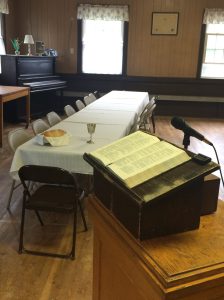
 Celebramos el sacramento de la Cena del Señor tres veces por año, normalmente el tercer dia del Señor (Domingo) de Enero, Mayo, y Septiembre. El Domingo anterior, tenemos un servicio ‘preparatorio,’ en el cual a los miembros se les exhorta que examinen y preparen sus corazones para el sacramento. Se invita a los comunicantes celebrar la Cena del Señor que se conmemora alrededor de una mesa comun al frente de la iglesia. La celebracion utiliza un pan comun y una copa comunal de vino las cuales son distribuidas por turno a cada miembro sentado a la mesa.
Todos los que son miembros completos en buen estado de esta o cualquier otra congregacion de la Iglesia Reformada Presbyteriana son invitados celebrar la Cena del Señor con nosotros. Miembros de otras iglesias que confiesan el mismo evangelio y que visitan primero com los ancianos tambien pueden participar.
Niños bautizados de la iglesia, mientras no elegibles para venir hasta que lleguen a la 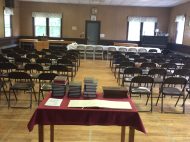 edad mayor y den una profesion creible de su propia fe, junto con otras visitas que se les pide observar la celebracion son ehortados buscar a Cristo. Miembros bautizados o visitas regulares interesadas en unirse a la iglesia deben de hablar con el ministro para arreglas un tiempo de instruccion en las cosas basicas de la fe Cristiana y los beneficios y responsabilidades de la membresia.

![IMG_3868[1]](https://reformedparish.com/wp-content/uploads/2019/11/img_38681.jpg?w=158&h=211) “Cuan grande debe ser ese amor que produjo el bello tejido del universo, sin la ayuda de causa material alguna! Esto proclama que es verdaderamente infinito: pues nada menos podria unir extremos tan distantes como el nada y el ser…Es por el Poder Divino que los objetos celestiales had rodado constantes en sus esferas por tantas edades, sin gastarse o salirse de su propio curso; y que los elementos tumultuosos han perseverado en su orden hasta el dia de hoy. El preserva las alianzas de la naturaleza, pone fronteras al mar rugiente, y lo mantiene dentro de sus limites con una faja de arena.”
“Cuan grande debe ser ese amor que produjo el bello tejido del universo, sin la ayuda de causa material alguna! Esto proclama que es verdaderamente infinito: pues nada menos podria unir extremos tan distantes como el nada y el ser…Es por el Poder Divino que los objetos celestiales had rodado constantes en sus esferas por tantas edades, sin gastarse o salirse de su propio curso; y que los elementos tumultuosos han perseverado en su orden hasta el dia de hoy. El preserva las alianzas de la naturaleza, pone fronteras al mar rugiente, y lo mantiene dentro de sus limites con una faja de arena.”![IMG_3868[1]](https://reformedparish.com/wp-content/uploads/2019/11/img_38681.jpg?w=144&h=192) “O how great must that power be, which produced the beautiful fabric of the universe, without the concurrence of any material cause! This proclaims it to be truly infinite: for nothing less could make such distant extremes as nothing and being to meet together. . . It is by the Divine Power that the heavenly bodies have constantly rolled about in their spheres for so many ages, without wearing or moving out of their proper course; and that the tumultuous elements have persisted in their order to this very day. He preserves the confederacies of nature, sets bounds to the raging sea, and keeps it within its limits by a girdle of sand.”
“O how great must that power be, which produced the beautiful fabric of the universe, without the concurrence of any material cause! This proclaims it to be truly infinite: for nothing less could make such distant extremes as nothing and being to meet together. . . It is by the Divine Power that the heavenly bodies have constantly rolled about in their spheres for so many ages, without wearing or moving out of their proper course; and that the tumultuous elements have persisted in their order to this very day. He preserves the confederacies of nature, sets bounds to the raging sea, and keeps it within its limits by a girdle of sand.”
 The following quote will strike our death-insulated, secular, consumerist age as morbid if not cruel. But as death is inescapable, we would do well to learn from a wiser generation
