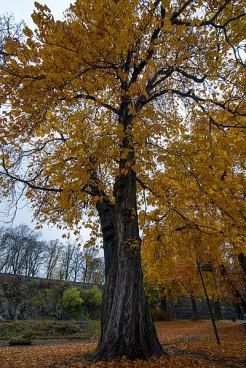
 “This tree is my everlasting salvation. It is my food, a shared banquet. Its roots and the spread of its branches are my own roots and extension. In its shade, as in a breeze, I luxuriate and am cared for. Its shade I take for my resting place; in my flight from oppressive heat it is a source of refreshing dew for me. Its blossoms are my own, my utter delight its fruits, saved from the beginning for my harvest. Food for my hunger and well-spring for my thirst, it is also a covering for my nakedness, with the spirit of life as its leaves. Far from me henceforth the fig leaves!
“Fearful of God, I find it a place of safety; when unsteady, a source of stability. In the face of a struggle, I look to it as a prize; in victory, my trophy. It is the narrow path, the restricted road. It is Jacob’s ladder, the passage of angels, at whose summit the Lord is affixed. This tree, the plant of immortality, rears from earth to reach as high as heaven, fixing the Lord between heaven and earth. It is the foundation and stabilizer of the universe, undergirding the world that we inhabit. It is the binding force of the world and holds together all the varieties that human life encompasses. It is riveted into a unity by the invisible bonds of the Spirit, so that its connection with God can never be severed.
“Brushing heaven with its uppermost branches, it remains fixed in the earth and, between the two points, its huge hands completely enfold the stirring of the air. As a single whole it penetrates all things and all places.”
-Pseudo-Hippolytus (tr. by B. Ramsay)

 “Todo hombre que tiene su esperanza en Cristo, se purifica a sí mismo”. 1 Juan 3: 3. Un sermón de J. C. Ryle (1816-1900)
 “God is wholly one Deut. 6. 4. Gal. 3. 20. 1 Tim. 2. 5. Hos. 13. 4. Mal. 2. 10. All creatures are subject to multiplication; there may be many of them and are many; many Angels, men, starres, and so in the rest. Not one of them is singular and onely one so; but one might conceive that there should be more; for he that made one of them, can make another and another, and as many as he pleaseth; but God is simply one, singular, and sole essence; there neither is, nor can be more then one God, because he is the first and best essence; and there can be but one first, and one best. He is Infinite, and there cannot be but one Infinite because either one of them should include the other, and so the included must needs be finite, or not extend to the other, and so it self not be Infinite. There was a first man, and a first in every kind of creature, but not any absolute first save God: one Eternall, and one Incomprehensible, saith Athanasius in his Creed.”
 II. God has all life,