“Is any merry? Let him sing psalms!” (an offer)

Thus, the Apostle James (Jas. 5:13). Accordingly, the New England Puritans and colonial Presbyterians worshipped the Lord in their church meetings with a capella psalm singing to metrical, rhymed versions of the Psalter. Our godly forefathers worshipped this way, believing it to be the rule for all the New Testament churches. To learn more, see here and here.

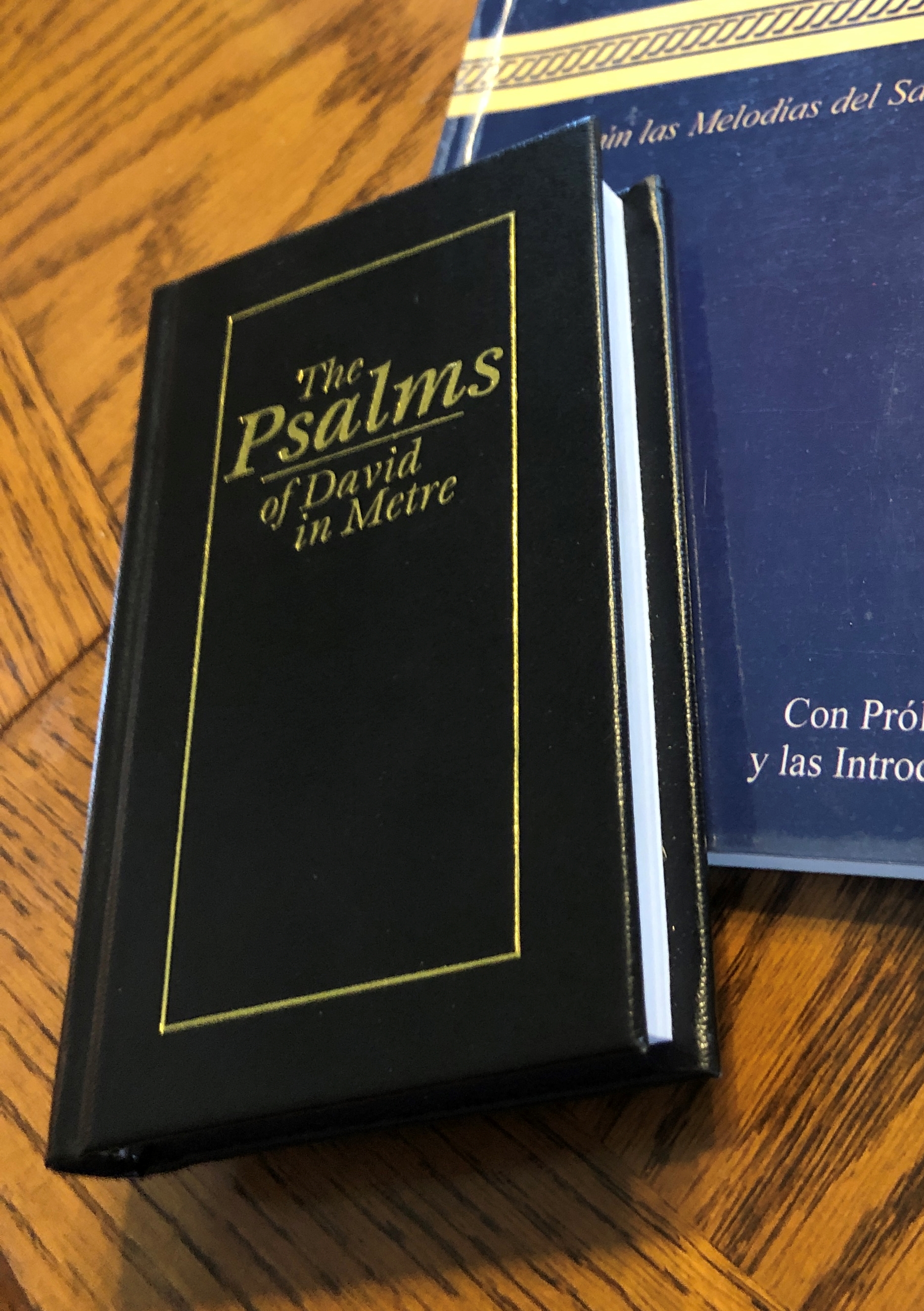
In the interests of reviving psalm-singing among Christians in the northeast, we are giving away five free copies of The Psalms of David in Metre (1650) to the first five who respond from anywhere in New Jersey, greater Philadelphia, or the New York metro — provided you don’t already belong to a psalm-singing (EP) church or already have a copy. If you would like to try signing the psalms, try joining in here. To get one of these free copies, drop me a note at michael at reformedparish dot com with your address, and we’ll drop it in the mail.

Consider John Calvin’s commendation of psalm-singing in his preface to the Geneva Psalter of 1543:
So what are we to do? We should have songs that are not only upright but holy, that will spur us to pray to God and praise Him, to meditate on His works so as to love Him, to fear Him, to honour Him, and glorify Him. For what St. Augustine said is true, that one can sing nothing worthy of God save what one has received from Him. Wherefore though we look far and wide we will find no better songs nor songs more suitable to that purpose than the Psalms of David, which the Holy Spirit made and imparted to him. Thus, singing them we may be sure that our words come from God just as if He were to sing in us for His own exaltation. Wherefore, Chrysostom exhorts men, women, and children alike to get used to singing them, so as through this act of meditation to become as one with the choir of angels.”

Bautizándolos

Creo que cuando las personas miran el bautismo, tienen una comprensión limitada de por qué Jesús ordenó que bauticemos a Sus discípulos. La mayoría de las personas probablemente asocian el agua con la limpieza, que es una conexión precisa dado el mensaje del profeta Ezequiel de que Dios rociaría agua sobre Su pueblo (Ez. 36:25). La limpieza del pecado, sin embargo, es solo un elemento en el significado e importancia del bautismo.

Lea más aquí, por J. V. Fesko.

Expository preaching?

R.L. Dabney. “. . . the expository method (understood as that which explains extended passages of Scripture in course) [must] be restored to that equal place which it held in the primitive and Reformed Churches; for, first, this is obviously the only natural and efficient way to do that which is the sole legitimate end of preaching, convey the whole message of God to the people.”

R. B. Kuiper. “In short, expository preaching demands that, by careful analysis of each text within its immediate context and the setting of the book to which it belongs, the full power of modern exegetical and theological scholarship be brought to bear upon our treatment of the Bible. The objective is not that the preacher may parade all this scholarship in the pulpit. Rather, it is that the preacher may speak faithfully out of solid knowledge of his text, and mount the pulpit steps as, at least, “a workman who has no need to be ashamed, rightly handling the word of truth.”

Ligon Duncan. “Expository preaching is the faithful explanation and application of the Bible in which the text of Scripture supplies the matter of the preacher’s exhortations rather than the preacher using the text as an occasion for his own expostulations, however helpful they may be.”

What is “justification?”

I. Those whom God effectually calleth he also freely justifieth;a not by infusing righteousness into them, but by pardoning their sins, and by accounting and accepting their persons as righteous: not for anything wrought in them, or done by them, but for Christ’s sake alone; nor by imputing faith itself, the act of believing, or any other evangelical obedience to them, as their righteousness; but by imputing the obedience and satisfaction of Christ unto them,b they receiving and resting on him and his righteousness by faith; which faith they have not of themselves, it is the gift of God.c

a. Rom 3:248:30. bJer 23:6Rom 3:2224-2527-284:5-85:17-191 Cor 1:30-312 Cor 5:1921Eph 1:7Titus 3:57. c. Acts 10:4413:38-39Gal 2:16Eph 2:7-8Phil 3:9.

-Westminster Confession of Faith (1646), 11.1

Christianity’s shocking emergence

“No other sufficient cause can possibly be assigned of this propagation the gospel, but only God’s own power. Nothing else can be devised as the reason of it but this. Their was certainly some reason Here was a great and wonderful effect the most remarkable change that ever was in the face of the world of mankind since the flood; and this effect was not without some cause. Now, what other cause can be devised but only the divine power? It was not the outward strength of the instruments which were employed in it. At first, the gospel was preached only by a few fishermen, who were without power and worldly interest to support them. It was not their craft and policy that produced this wonderful effect; for they were poor illiterate men. It was not the agreeableness of the story they had to tell to the notions and principles of mankind. This was no pleasant able: a crucified God and Saviour was to the Jews a stumbling-block, and to the Greeks foolishness. It was not the agreeableness of their doctrines to the dispositions of men: for nothing is more contrary to the corruptions of men than the pure doctrines of the gospel. This effect therefore can have proceeded from no other cause than the power and agency of God: and if the power of God was what was exercised to cause the gospel to prevail, then the gospel is his word; for surely God does not use his almighty power to promote a mere imposture and delusion.”

-Jonathan Edwards (1703–1758)

Is sex before marriage really a sin?

A pretty good, short overview of the question from the Scriptures. Open your mind to God, and go deaf to the culture and your own deceitful heart!

My only caveat is that the speaker uses a Bible version that translates the Greek word porneia as “sexual immorality” and not “fornication.” I prefer the latter, since the former is too vague. But other than that, the content is spot-on.

Death, the “private judgment”

It is appointed unto men once to die, but after that the judgment” (Heb. 9:27). This teaches that prior to death, man’s destiny is not decided, he being not yet sentenced; but after death, his destiny is settled. When he dies, the “private judgment,” that is, the immediate personal consciousness either of penitence or impenitence, occurs. Every human spirit, in that supreme moment when it “returns to God who gave it,” knows by direct self-consciousness whether it is a child or an enemy of God, in temper and disposition; whether it is humble and contrite, or proud, hard, and impenitent; whether it welcomes or rejects the Divine mercy in Christ. The article of death is an event in human existence which strips off all disguises, and slows the person what he really is, in moral character. He “knows as he is known,” and in this flashing light passes a sentence upon himself that is accurate. This “private judgment” at death, is reaffirmed in the “general judgment” of the last day.

-W.G.T. Shedd