Christ’s return to judgment, the completion of His work

662a7aecb7“. . . the return of Christ unto judgment is not an arbitrary addition that can be isolated from his preceding work and viewed by itself.  It is a necessary and indispensable component of that work.  It brings that work to completion and crowns it.  It is the last and highest step in the state of his exaltation.

“Because Christ is the savior of the world, he will someday return as its judge.  The crisis,  or judgment (krisis),  that he precipitated by his first coming he consummates at the second coming.  The Father gave him authority to execute judgment (krisin poeiein) because he is the Son of Man (John 5:27).  Eschatology, therefore, is rooted in Christology and is itself Christology, the teaching of the final, complete triumph of Christ and his kingdom over all his enemies.  In accord with Scripture, we can go back even further.  The Son is not only the mediator of reconciliation (mediator reconciliatonis) on account of sin, but even apart from sin he is the mediator of union (mediator unionis) between God and his creation.  He is not only the exemplary cause (causa exemplaris) but also the final cause (causa finalis) of creation.  In the Son the world  has its foundation and example, and therefore it has in him its goal as well.  It is created through him and for hims as well (Col. 1:16).  Because the creation is his work, it cannot and may not remain the booty of Satan.  The Son is the head, Lord, and heir of all things.  United in the Son, gathered under him as their  head, all creatures return to the Father, the fountain of all good.  The second coming is therefore required by his first coming.  It is implied in the first; in time, by inner necessity, it will proceed from the first; the second coming brings the first coming to its full effect and completion and was therefore comprehended in a single image with the first coming by Old Testament prophecy.”

– Herman Bavinck, Reformed Dogmatics (4:685).

O the Sweet Exchange!

Altar-of-Sacrifice“And when our iniquity had been fully accomplished, and it had been made perfectly manifest that punishment and death were expected as its recompense, and the season came which God had ordained, when henceforth He should manifest His goodness and power (O the exceeding great kindness and love of God), He hated us not, neither rejected us, nor bore us malice, but was long-suffering and patient, and in pity for us took upon Himself our sins, and Himself parted with His own Son as a ransom for us, the holy for the lawless, the guileless for the evil, the just for the unjust, the incorruptible for the corruptible, the immortal for the mortal. For what else but His righteousness would have

covered our sins?

“In whom was it possible for us lawless and ungodly men to have been justified, save only in the Son of God?

“O the sweet exchange, O the inscrutable creation, O the unexpected benefits; that the iniquity of many should be concealed in One Righteous Man, and the righteousness of One should justify many that are iniquitous!”

Epistle to Diognetus, 5:2-5 (ca. 150 A.D.)

Of spectators and combatants

“Perhaps you wonder, ‘Why are the wicked joyous? why do they live in luxury? why don’t they have to strive like I do?’

“The reason is that they who have not signed up to strive for the crown are not required to undergo the labors of the contest. Those who haven’t gone down to the track don’t smear themselves with oil, nor get covered with dust. Trouble comes only to those on their way to glory. The perfumed spectators prefer to watch, not to join in the struggle, nor to endure the sun, the heat, the dust, and the rain.

“So those who have devoted themselves to pleasures, luxury, robbery, gain or honors are spectators rather than combatants. They have the profit of labor but the not the fruits of virtue. They love their ease. By cunning and wickedness they heap up riches. But they will pay the penalty of their iniquity, though it be late in coming. Their rest will be in hell, yours in paradise. Thus, Job said beautifully that they watch in the tomb (see Job 21:32), for they cannot have the calm of quiet rest that he enjoys who shall rise again.”

-Ambrose of Milan (337-397 A.D.)

Mere nothing, the servant of Omnipotence

light_up_the_dark_by_xdante_stock“Mere nothing is a servant to Omnipotency. He sendeth his mandate or statute of heaven to mere nothing; and darkness, as the sergeant and pursuivant [officer of arms] of God, must send out light, by virtue of a creating mandate.”  – Samuel Rutherford (1600-1661)

“For God, who commanded the light to shine out of darkness, hath shined in our hearts, to givethe light of the knowledge of the glory of God in the face of Jesus Christ” (1 Corinthians 4:6).

The ineffable patience of God

So, although in God there can be no suffering, and patience has its name apatiendo, from suffering, yet a patient God we not only faithfully believe, but also wholesomely confess. But the patience of God, of what kind and how great it is, His, Whom we say to be impassible, yet not impatient, nay even most patient, in words to unfold this who can be able? Ineffable is therefore that patience, as is His jealousy, as His wrath and whatever there is like to these. For if we conceive of these as they be in us, in Him are there none. We, namely, can feel none of these without molestation: but be it far from us to surmise that the impassible nature of God is liable to any molestation. But like as He is jealous without any darkening of spirit, angry without any perturbation, pitiful without any pain, repents Him without any wrongness in Him to be set right; so is He patient without anything of passion.

-Augustine


The blessed God

I recently preached on the words of Christ to His faithful servants on the last day, “Enter into the joy of thy Lord.”  This text, among other things, opens up a window into the joy, the happiness, or what some biblical texts speak of as the “blessedness of God” (Rom. 9:5, 1 Tim. 1:11, 6:15).  It is the joy of the Lord.

imagesGod is the self-sufficient One, who enjoys true happiness in and of Himself.  One Swiss Reformed theologian, Benedict Pictet (1655-1724) said of God, “Who would not call God happy, who is in need of nothing, finds comfort in himself, and possesses all things; is free from all evil and filled with all good?”

When Christ speaks to the believer on the last day and ushers him with open arms into “the joy of the Lord,” He is welcoming that believer into the full participation of God’s happiness – at least as far as a creature can possibly sustain in the narrow limits of his being.  What a grand thought.  God wants to share His joy!

Are you, friend, truly happy?  Can you be happy without the blessed God?  Come to Him, then, through Christ – through whom He lavishly pours out joy “unspeakable and full of glory.”

The Spirit & the Bride

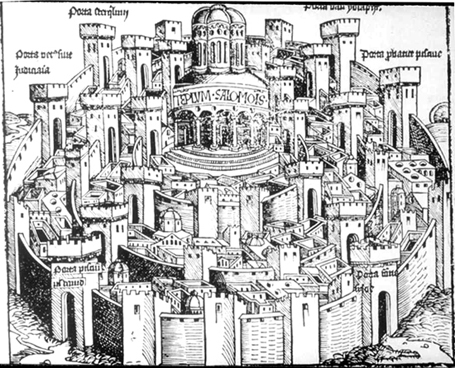
wolgemutpleydenwurffFor where the Church is, there is the Spirit of God; and where the Spirit of God is, there is the Church, and every kind of grace; but the Spirit is truth. Those, therefore, who do not partake of Him, are neither nourished into life from the mother’s breasts, nor do they enjoy that most limpid fountain which issues from the body of Christ; but they dig for themselves broken cisterns out of earthly trenches, and drink putrid water out of the mire, fleeing from the faith of the Church lest they be convicted; and rejecting the Spirit, that they may not be instructed.

-Irenaeus of Lyons (d. ca. 202)