
Category: The Good News
The Book of Exodus
“The wrathful God is made loving”
“Secondly, propitiation is not a turning of the wrath of God into love. The propitiation of the divine wrath, effected in the expiatory work of Christ, is the provision of God’s eternal and unchangeable love, so that through the propitiation of his own wrath that love may realize its purpose in a way that is consonant with and to the glory of the dictates of his holiness. It is one thing to say that the wrathful God is made loving. That would be entirely false. It is another thing to say the wrathful God is loving. That is profoundly true. But it is also true that the wrath by which he is wrathful is propitiated through the cross. This propitiation is the fruit of the divine love that provided it. “Herein is love, not that we loved God, but that he loved us and sent his Son to be the propitiation for our sins” (I John 4:10). The propitiation is the ground upon which the divine love operates and the channel through which it flows in achieving its end.”
-John Murray, Redemption Accomplished & Applied
The cross, the Tree of Life
 “This tree is my everlasting salvation. It is my food, a shared banquet. Its roots and the spread of its branches are my own roots and extension. In its shade, as in a breeze, I luxuriate and am cared for. Its shade I take for my resting place; in my flight from oppressive heat it is a source of refreshing dew for me. Its blossoms are my own, my utter delight its fruits, saved from the beginning for my harvest. Food for my hunger and well-spring for my thirst, it is also a covering for my nakedness, with the spirit of life as its leaves. Far from me henceforth the fig leaves!
“Fearful of God, I find it a place of safety; when unsteady, a source of stability. In the face of a struggle, I look to it as a prize; in victory, my trophy. It is the narrow path, the restricted road. It is Jacob’s ladder, the passage of angels, at whose summit the Lord is affixed. This tree, the plant of immortality, rears from earth to reach as high as heaven, fixing the Lord between heaven and earth. It is the foundation and stabilizer of the universe, undergirding the world that we inhabit. It is the binding force of the world and holds together all the varieties that human life encompasses. It is riveted into a unity by the invisible bonds of the Spirit, so that its connection with God can never be severed.
“Brushing heaven with its uppermost branches, it remains fixed in the earth and, between the two points, its huge hands completely enfold the stirring of the air. As a single whole it penetrates all things and all places.”
-Pseudo-Hippolytus (tr. by B. Ramsay)
Saving world from world
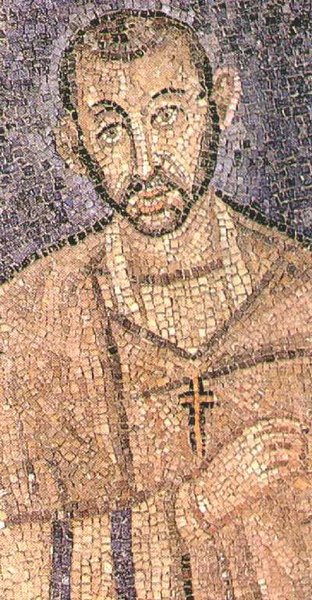 “The people of God have their fulness, and although a large portion of men either neglect, or reject, the grace of the Saviour, yet there is a certain Special Universality of the elect, and foreknown, separated and discerned from the generality of all, that a whole world might seem to be saved out of a whole world; and all men might seem to be redeemed out of all men.”
-Ambrose (c. 340-397)
This quote is striking as it aligns with the later Calvinist doctrine of particular redemption (‘limited atonement’), that is, Christ died not for every human being who has ever lived, but for those chosen by God from the foundation of the world. By His blood, Christ dies for and ransoms a world out of the world, and that bought world takes its place at the end of time.
Ambrose, incidentally, was the pastor of Augustine (354-430), one of the Church’s greatest theologians.
From star & crescent to Christ
A tremendous story about a radical, Lebanese Muslim finding Jesus – and becoming a conservative Lutheran pastor to boot! I was struck by the close similarities he drew between the works righteousness of Islam and the old Roman bondage from which Luther was set free. “By grace are ye saved through faith; and that not of yourselves; it is the gift of God: not of works, lest any man should boast” (Eph. 2:8-9).
The friendly-minded God
‘The end and intent of the Scripture is to declare that God is benevolent and friendly-minded to mankind; and that he hath declared that kindness in and through Jesu Christ, his only Son; the which kindness is received by faith.”
-from Protestant martyr George Wishart’s (1513-1546) translation of the First Helvetic Confession (1536)
The annihilation of death
 The [Apostles’] Creed next mentions, that he “was dead and buried”. Here again it is necessary to consider how he substituted himself in order to pay the price of our redemption. Death held us under its yoke, but he in our place delivered himself into its power, that he might exempt us from it. This the Apostle means when he says, “that he tasted death for every man,” (Heb 2:9). By dying he prevented us from dying; or (which is the same thing) he by his death purchased life for us. But in this he differed from us, that in permitting himself to be overcome of death, it was not so as to be engulfed in its abyss, but rather to annihilate it, as it must otherwise have annihilated us; he did not allow himself to be so subdued by it as to be crushed by its power; he rather laid it prostrate, when it was impending over us, and exulting over us as already overcome. In fine, his object was, “that through death he might destroy him that had the power of death, that is, the devil, and deliver them who through fear of death were all their lifetime subject to bondage,” (Heb 2:14-15).
-John Calvin
The Savior of the world

Here is a short clip from our recent morning sermon, “The Announcement of the Lamb,” an exposition of John 1:29. For the complete sermon, click here
The Lamb of God
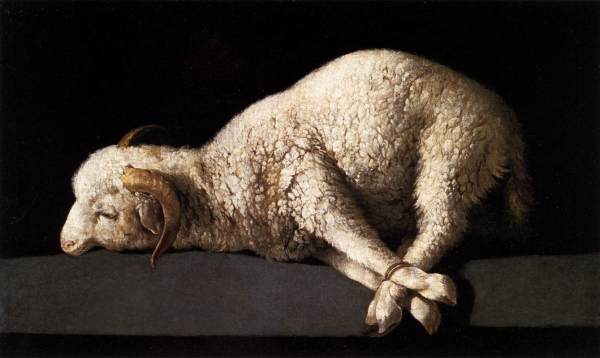 The lamb is a symbol of everything tender, innocent, and wholly dependent. As an urbanite from boyhood, I have only seen lambs occasionally. My last lamb sighting was on a trip in England. While running through the beautiful countryside, some of these absolutely adorable little creatures arrested me on the roadside. The aww-factor was off the charts!
John the Baptist, the forerunner of Jesus Christ, when seeing him among the crowds cried out, “Behold, the Lamb of God!” Now, the above symbolism rang true for Jesus. He was the epitome of harmless good. He was the man of peace, through and through. But there was much more to the lamb-symbolism for Jesus. The image God gave in the lamb-symbolism was also one blood and gore, because the Old Testament lamb was raised to be a victim. A sacrificial victim.
Why? Is this just a crude hold-over from primitive, superstitious peoples? Are we moderns right to say we have moved on from these gruesome ideas? Really, is the meaning of the cross still meaningful?
Join us as we consider these issues in our Sunday morning service on May 6.

