
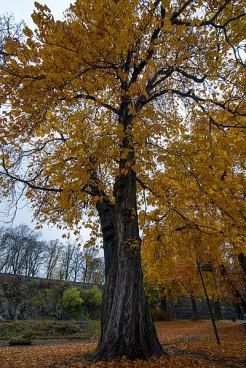
 “This tree is my everlasting salvation. It is my food, a shared banquet. Its roots and the spread of its branches are my own roots and extension. In its shade, as in a breeze, I luxuriate and am cared for. Its shade I take for my resting place; in my flight from oppressive heat it is a source of refreshing dew for me. Its blossoms are my own, my utter delight its fruits, saved from the beginning for my harvest. Food for my hunger and well-spring for my thirst, it is also a covering for my nakedness, with the spirit of life as its leaves. Far from me henceforth the fig leaves!
“Fearful of God, I find it a place of safety; when unsteady, a source of stability. In the face of a struggle, I look to it as a prize; in victory, my trophy. It is the narrow path, the restricted road. It is Jacob’s ladder, the passage of angels, at whose summit the Lord is affixed. This tree, the plant of immortality, rears from earth to reach as high as heaven, fixing the Lord between heaven and earth. It is the foundation and stabilizer of the universe, undergirding the world that we inhabit. It is the binding force of the world and holds together all the varieties that human life encompasses. It is riveted into a unity by the invisible bonds of the Spirit, so that its connection with God can never be severed.
“Brushing heaven with its uppermost branches, it remains fixed in the earth and, between the two points, its huge hands completely enfold the stirring of the air. As a single whole it penetrates all things and all places.”
-Pseudo-Hippolytus (tr. by B. Ramsay)
 The [Apostles’] Creed next mentions, that he “was dead and buried”. Here again it is necessary to consider how he substituted himself in order to pay the price of our redemption. Death held us under its yoke, but he in our place delivered himself into its power, that he might exempt us from it. This the Apostle means when he says, “that he tasted death for every man,” (Heb 2:9). By dying he prevented us from dying; or (which is the same thing) he by his death purchased life for us. But in this he differed from us, that in permitting himself to be overcome of death, it was not so as to be engulfed in its abyss, but rather to annihilate it, as it must otherwise have annihilated us; he did not allow himself to be so subdued by it as to be crushed by its power; he rather laid it prostrate, when it was impending over us, and exulting over us as already overcome. In fine, his object was, “that through death he might destroy him that had the power of death, that is, the devil, and deliver them who through fear of death were all their lifetime subject to bondage,” (Heb 2:14-15).
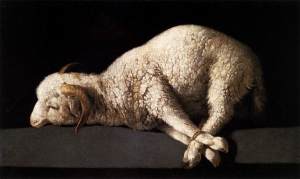 The lamb is a symbol of everything tender, innocent, and wholly dependent. As an urbanite from boyhood, I have only seen lambs occasionally. My last lamb sighting was on a trip in England. While running through the beautiful countryside, some of these absolutely adorable little creatures arrested me on the roadside. The aww-factor was off the charts!
 The Reformed Parish