
 The [Apostles’] Creed next mentions, that he “was dead and buried”. Here again it is necessary to consider how he substituted himself in order to pay the price of our redemption. Death held us under its yoke, but he in our place delivered himself into its power, that he might exempt us from it. This the Apostle means when he says, “that he tasted death for every man,” (Heb 2:9). By dying he prevented us from dying; or (which is the same thing) he by his death purchased life for us. But in this he differed from us, that in permitting himself to be overcome of death, it was not so as to be engulfed in its abyss, but rather to annihilate it, as it must otherwise have annihilated us; he did not allow himself to be so subdued by it as to be crushed by its power; he rather laid it prostrate, when it was impending over us, and exulting over us as already overcome. In fine, his object was, “that through death he might destroy him that had the power of death, that is, the devil, and deliver them who through fear of death were all their lifetime subject to bondage,” (Heb 2:14-15).
-John Calvin

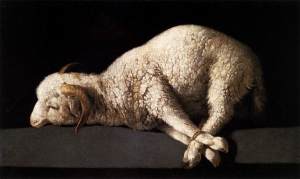 The lamb is a symbol of everything tender, innocent, and wholly dependent. As an urbanite from boyhood, I have only seen lambs occasionally. My last lamb sighting was on a trip in England. While running through the beautiful countryside, some of these absolutely adorable little creatures arrested me on the roadside. The aww-factor was off the charts!
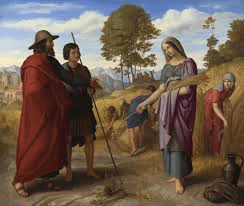 “Now it came to pass in the days when the judges ruled, that there was a famine in the land. And a certain man of Bethlehemjudah went to sojourn in the country of Moab, he, and his wife, and his two sons” (Ruth 1:1).
 “What shall I say! And how shall I describe this Birth to you? For this wonder fills me with astonishment. The Ancient of days has become an infant. He Who sits upon the sublime and heavenly Throne, now lies in a manger. And He Who cannot be touched, Who is simple, without complexity, and incorporeal, now lies subject to the hands of men. He Who has broken the bonds of sinners, is now bound by an infants bands. But He has decreed that ignominy shall become honor, infamy be clothed with glory, and total humiliation the measure of His Goodness.”
 “. . . the return of Christ unto judgment is not an arbitrary addition that can be isolated from his preceding work and viewed by itself. It is a necessary and indispensable component of that work. It brings that work to completion and crowns it. It is the last and highest step in the state of his exaltation.
 “And when our iniquity had been fully accomplished, and it had been made perfectly manifest that punishment and death were expected as its recompense, and the season came which God had ordained, when henceforth He should manifest His goodness and power (O the exceeding great kindness and love of God), He hated us not, neither rejected us, nor bore us malice, but was long-suffering and patient, and in pity for us took upon Himself our sins, and Himself parted with His own Son as a ransom for us, the holy for the lawless, the guileless for the evil, the just for the unjust, the incorruptible for the corruptible, the immortal for the mortal. For what else but His righteousness would have
 The Reformed Parish